

We've Come a Long Way
Gebauer is founded in 1901
Gebauer Company begins supplying Ethyl Chloride to the U.S. armed forces.
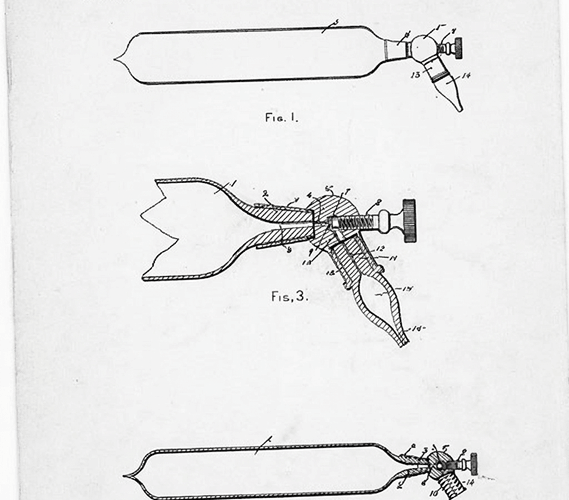
In 1906, Charles Gebauer patents one of the industry’s first general anesthesia inhaling devices for use with Ethyl Chloride. In 1918, the iconic product ships off with the troops to the front lines of World War I and, a few decades later, World War II.

Gebauer is acquired by the Rose family and business continues to flourish
The Rose Family, manufacturers of Zemo liquid and paste products, acquires the Gebauer Company. Dr. Janet Travell, who had a close working relationship with Gebauer since the late 1940s, collaborated with Gebauer Company in developing Fluori-Methane in 1960.

Gebauer diversifies for market and environmental needs
Gebauer focuses on exploring new opportunities to expand its patient comfort line, and evolve with the changing requirements of the environment and healthcare market. The company continues its history of innovation by diversifying into new markets and by developing and acquiring new products.
Gebauer continues to innovate
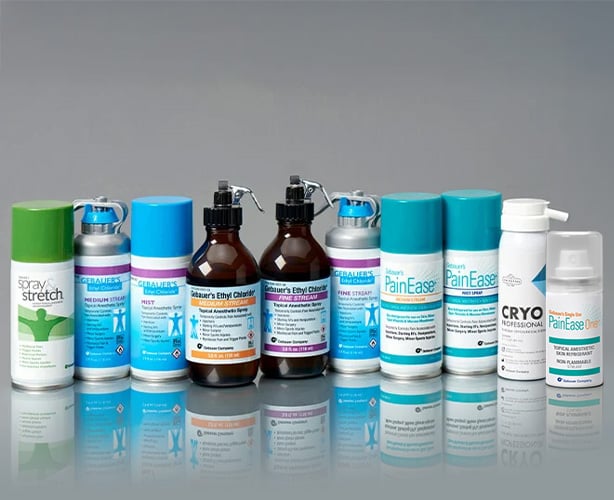
Gebauer’s Ethyl Chloride® Accu-Stream 360® with Sure Lock Technology® is introduced, and allows spray from almost any angle with a safety locking ring to help prevent accidental spraying.
In 2015, Gebauer Company adds Gebauer’s PainEase® in a new single patient package to their extensive product line.
And in 2026, PainEase One™ is launched, a single-use topical anesthetic, to help healthcare organizations meet the growing demands to improve efficiency, standardize processes, and optimize resources while maintaining high-quality patient care.
Charles and Theophil Gebauer founded the Gebauer Company.
In 1901, brothers Charles and Theophil Gebauer founded the Gebauer Company. Their first product, Gebauer’s Ethyl Chloride®, was widely used in dental procedures until it was superseded by the introduction of Novocain, but it remained an effective local anesthetic for minor surgical operations.
The Gebauer Company flourished under the private ownership of the Gebauer brothers. The product became a fast favorite among physicians spanning multiple specialities and set a new standard for patient comfort.
In the early days, users would break the tip of a glass ampoule containing ethyl chloride, and pour ethyl chloride directly onto the patient. Unfortunately, this allowed little time for performing the medical procedure, and any leftover product was wasted. The Gebauer brothers noted this inefficiency and began exploring other options.
In 1901, Charles Gebauer patented a revolutionary design that changed how ethyl chloride was administered. This innovative mechanism allowed for jet stream dispensing of Gebauer's Ethyl Chloride and coupled with a reusable metal tube, changed how it was commercially marketed.
Gebauer Company begins supplying Ethyl Chloride to the U.S. armed forces.
One of the most popular products clinicians rely on to bring patients relief today was the same product used by medics on the front lines of some of the most influential battles in American history.
In 1918, the Gebauer Company began supplying Ethyl Chloride® to the U.S. Armed Forces. The product was used for both emergency surgeries on the battlefield, as well as pain relief, throughout World War I. Gebauer’s Ethyl Chloride returned to the battlefront during World War II both as a local anesthetic and as a treatment for sprained or strained muscles, helping soldiers return to the battlefield.
Additionally, between the two wars, the Gebauer Company patented the Gebauer Dispensal™ Cap and Bottle, and introduced Tannic Spray, an industry favorite used to ease minor burns. Later, in 1953, Gebauer introduced Fluro-Ethyl, a product widely adopted for dermabrasion treatments.
Dr. Janet Travell guides Gebauer in the production of Fluori-Methane.
Gebauer company was purchased by Ernie Rose, Jr. and his family following the death of Charles Gebauer in 1957. Ernie Rose, Sr. had developed and successfully marketed the over-the-counter astringent, Zemo, and the company continued to produce unique products for use by the medical industry.
During this time, Gebauer established a close working relationship with Dr. Janet Travell, a well-known physician and pioneer in the use of vapocoolants for the treatment of muscle spasm and myofascial pain syndromes. Dr. Travell wrote many articles and books detailing the use of ethyl chloride for trigger point therapy and a practice she deemed “spray and stretch.” The spray and stretch technique is still in practice today.
Dr. Travell is well known as White House Physician to Presidents John F. Kennedy and Lyndon B. Johnson. In 1960, Dr. Travell assisted the Gebauer Company in producing Gebauer's Fluori-Methane. Fluori-Methane was produced until 2004 when it was replaced by Gebauer’s Spray and Stretch®.
Gebauer releases new products and moves to its new state-of-the-art facility.
In June of 2004, Gebauer Company moved from its 84-year-old factory in Cleveland, Ohio, to a new state-of-the-art, 58,000 square foot facility. This same year, Gebauer’s Pain Ease® was cleared by the FDA for pain management during injections, intravenous procedures, and minor surgical procedures.
In January of 2008, the Gebauer Company completed construction of an environmentally controlled filling suite, an enhanced air purification system, and a new clean compressed air system. The project, which was designed to meet the requirements of a Class 100,000 Clean Room, significantly enhanced the environmental controls and monitoring of the vapocoolant production area.
Charles and Theophil Gebauer founded the Gebauer Company.
The Gebauer Company flourished under the private ownership of the Gebauer brothers. The product became a fast favorite among physicians spanning multiple specialities and set a new standard for patient comfort.
In the early days, users would break the tip of a glass ampoule containing ethyl chloride, and pour ethyl chloride directly onto the patient. Unfortunately, this allowed little time for performing the medical procedure, and any leftover product was wasted. The Gebauer brothers noted this inefficiency and began exploring other options.
In 1901, Charles Gebauer developed one of the earliest aerosol containers to be commercially marketed. This innovative resealable metal tube allowed for jet stream dispension of Gebauer’s Ethyl Chloride®, revolutionizing the product’s use.